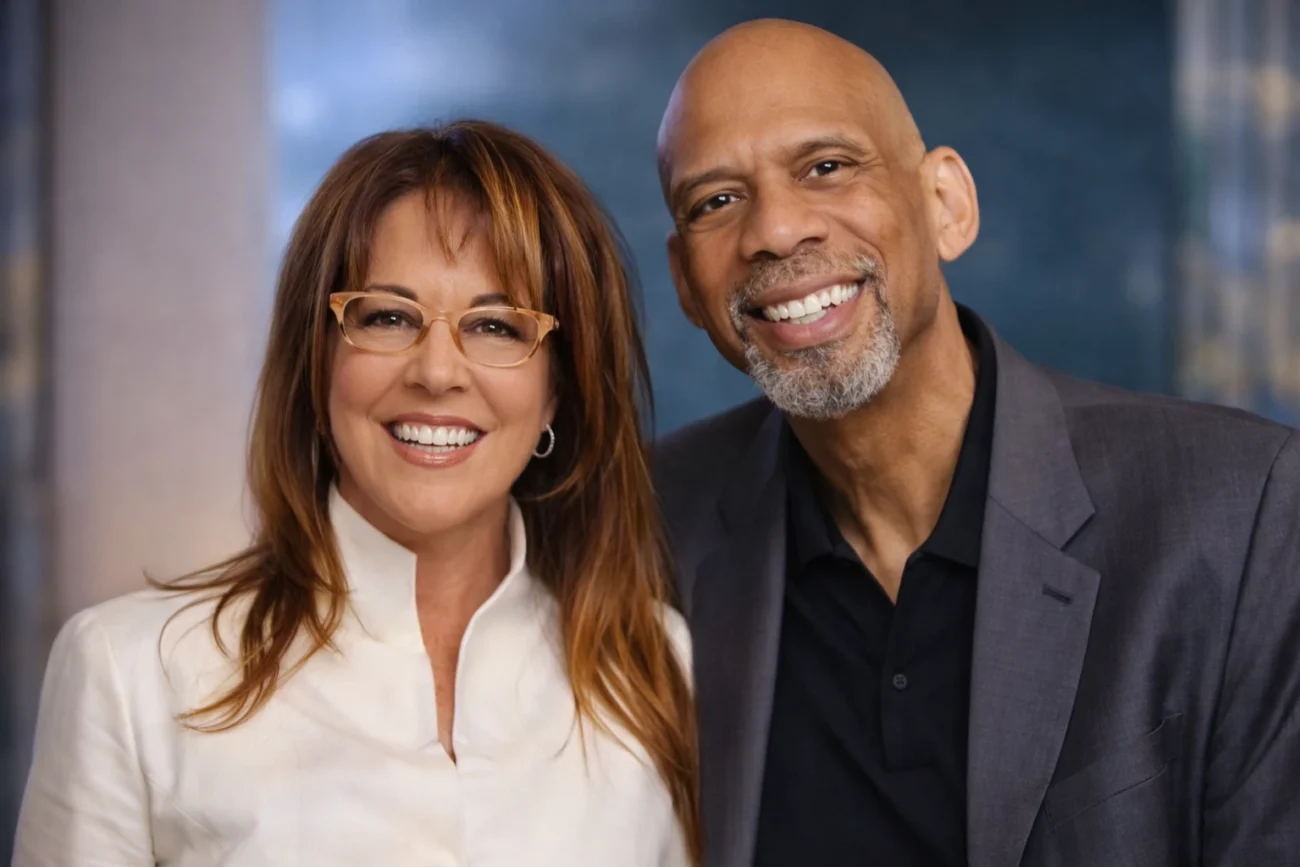
Cheryl Pistono’s name rarely appears on its own. It tends to surface in the margins of someone else’s story—most often that of Kareem Abdul-Jabbar, one of the most dominant and complex figures in basketball history. But to leave her there, as a supporting character, is to miss what makes her presence compelling. The glimpses that do exist—drawn from contemporaneous reporting, documentary appearances, and the quiet traces of a private life—suggest someone who was not simply adjacent to fame, but deeply involved in shaping the emotional and personal life of a man who spent much of his career guarded and misunderstood.
For readers who come searching for Cheryl Pistono, the expectations are often clear: a full biography, a neat timeline, a defined career. What they encounter instead is a sparse but telling record. The truth is that Pistono has remained largely outside the machinery of celebrity storytelling. What is known about her is anchored in a specific period, a specific relationship, and a handful of reliable sources. Yet within that narrow window, her influence stands out with unusual clarity.
Early Life and Background
The most credible public account of Cheryl Pistono’s early life comes from a 1980 Sports Illustrated profile of Kareem Abdul-Jabbar, written by journalist John Papanek. In that piece, Pistono is described as being from LaSalle, Illinois, a small Midwestern city far removed from the celebrity culture she would later brush against. The article places her age at 23 at the time, suggesting a birth year in the mid-1950s, though no official record has been widely confirmed.
According to the same source, Pistono’s upbringing was rooted in a working-class family. Her early life appears to have been shaped by both independence and friction. The article notes that she left home at 16, a decision that suggests a desire to chart her own course at a relatively young age. That departure marked the beginning of a transition that would take her from Illinois to the West Coast.
She later attended Beverly Hills High School, an environment that would have contrasted sharply with her Midwestern beginnings. The move placed her in proximity to a very different social world—one that intersected with entertainment, wealth, and public life. But the available descriptions of Pistono during this period emphasize not assimilation, but individuality. She is portrayed as someone who retained a strong sense of self rather than blending into the culture around her.
Religiously, Pistono’s journey also reflects change. Raised Catholic, she is described as having turned toward Buddhism in her later teenage years. That shift would later align with Kareem Abdul-Jabbar’s own Islamic faith, though their spiritual paths were not identical. What stands out is her willingness to question and redefine the beliefs she had grown up with, a trait that appears consistently in the way she is described by those who encountered her.
Meeting Kareem Abdul-Jabbar
Cheryl Pistono entered Kareem Abdul-Jabbar life in the late 1970s, a period marked by both professional success and personal unrest for the basketball star. Abdul-Jabbar had already established himself as one of the NBA’s most dominant players, but he was also known for his reserve, his seriousness, and a certain distance from the public and even from those around him.
The Sports Illustrated profile places their meeting in late 1977. At the time, Abdul-Jabbar was navigating the complexities of fame, identity, and personal relationships. Pistono, several years younger, came into that world with a different perspective. She was not part of the sports establishment, nor did she appear to be intimidated by it.
What’s striking in the reporting from that era is how quickly Pistono’s presence is framed as consequential. She is not introduced as a casual acquaintance or a fleeting companion. Instead, she is described as someone who engaged Abdul-Jabbar directly, challenged him, and refused to conform to the expectations that often surrounded him. In her own words, as quoted in the article, she recognized his pride and the way people tended to defer to him, and she did not follow that pattern.
Their relationship developed during a time when Abdul-Jabbar was still legally married to his first wife, Habiba Brown, though their marriage was in decline. Pistono’s arrival did not simply overlap with that period; it became part of the broader personal transition Abdul-Jabbar was undergoing. The dynamics of that transition are complex and not fully documented, but the available evidence suggests that Pistono’s influence was both personal and catalytic.
Influence on Abdul-Jabbar’s Personal Life
One of the most significant aspects of Cheryl Pistono’s story is the role she played in Abdul-Jabbar’s emotional and personal development. This is not a claim built on speculation; it comes directly from contemporaneous reporting. In the 1980 Sports Illustrated profile, Abdul-Jabbar is described as acknowledging that Pistono had a greater impact on his adult life than many of the other figures who had shaped his career.
That influence took several forms. Pistono is portrayed as someone who challenged Abdul-Jabbar’s tendencies toward isolation and emotional withdrawal. She questioned his behavior, pushed him to engage more openly with others, and encouraged him to confront aspects of his personality that he had long avoided addressing. This was not a passive form of support. It was active, sometimes confrontational, and rooted in a belief that he could be more than he was allowing himself to be.
The article describes moments that illustrate this dynamic. Pistono would interrupt conversations, correct him, or tease him in ways that broke through his usual reserve. She also encouraged him to reconsider how he interacted with the world around him, from his relationships to his public demeanor. These interactions were not always comfortable, but they were presented as meaningful.
There is also evidence that Pistono played a role in Abdul-Jabbar’s decision to pursue a divorce from Habiba Brown. While the details of that process remain private, the reporting suggests that Pistono’s presence and perspective were part of the factors that led him to make that change. It is important to approach this aspect carefully, as it involves personal decisions and relationships that extend beyond the public record. Still, the acknowledgment of her influence from Abdul-Jabbar himself gives weight to her role.
Beyond the larger decisions, Pistono’s influence can also be seen in smaller, everyday moments. She is described as someone who brought humor and lightness into Abdul-Jabbar’s life, whether through shared activities like roller skating or through the simple act of conversation. These details may seem minor, but they contribute to a fuller picture of a relationship that was both intimate and impactful.
Family Life and Motherhood
Cheryl Pistono’s connection to Kareem Abdul-Jabbar is not limited to their relationship in the late 1970s. It also includes their son, Amir Abdul-Jabbar. This is one of the most firmly established facts about her life, confirmed by Abdul-Jabbar’s official records and other reliable sources.
Amir Abdul-Jabbar has built a career that stands apart from his father’s athletic legacy. He is a physician specializing in orthopedic and spine surgery, with professional listings placing him in Washington state. His career reflects a path shaped by education and discipline rather than public visibility. While details about his upbringing remain largely private, his professional achievements offer a glimpse into the values that may have influenced his early life.
The available public record does not provide a detailed account of Pistono’s role as a mother, but her presence in Amir’s life is implicit in the family connection. Kareem Abdul-Jabbar has spoken publicly about his children in various contexts, often with pride. In one account, he described Amir as a source of support during his own health challenges, highlighting the strength of their relationship.
What remains less clear is how Pistono’s life evolved in the years following her relationship with Abdul-Jabbar. There is no widely confirmed information about subsequent marriages, additional children, or long-term career paths. This absence of detail is not unusual for someone who has chosen to remain outside the public eye, but it does limit the scope of what can be said with certainty.
Public Appearances and Media Presence
Despite her generally private life, Cheryl Pistono has made at least one documented appearance in a public media context. She appears as herself in the 2015 documentary Kareem: Minority of One, a film that explores Abdul-Jabbar’s life, career, and personal evolution. Her inclusion in the documentary suggests a willingness to contribute to the historical record, at least in a limited way.
The documentary itself focuses primarily on Abdul-Jabbar, but the presence of figures like Pistono adds depth to the narrative. It reinforces the idea that his life was shaped not only by his achievements on the court but also by the relationships and experiences that influenced him off it. Pistono’s participation, even briefly, places her within that broader context.
In more recent years, interest in Cheryl Pistono has been revived by popular culture. The HBO series Winning Time: The Rise of the Lakers Dynasty introduced her as a character, portrayed by actress Sarah Ramos. The show dramatizes the rise of the Los Angeles Lakers in the 1980s, blending historical events with fictionalized elements.
While Winning Time brought Pistono’s name back into public conversation, it also blurred the line between fact and fiction. Abdul-Jabbar himself criticized the series for its portrayal of events and characters, arguing that it prioritized drama over accuracy. As a result, viewers seeking to understand Pistono’s real life must look beyond the show to more reliable sources.
The Challenge of Sparse Records
One of the defining features of Cheryl Pistono’s biography is the scarcity of verified information. Unlike many figures connected to high-profile individuals, she did not cultivate a public persona or leave behind a trail of interviews, social media presence, or professional records that can be easily accessed. This absence has created space for speculation, much of which has been amplified by low-quality online content.
A simple search for her name yields a wide range of conflicting claims. Some sources assign her specific birth dates, careers, or later-life achievements that cannot be confirmed by reliable evidence. Others present detailed narratives that appear to be built on assumptions rather than documentation. These inconsistencies highlight the importance of distinguishing between what is known and what is merely repeated.
The truth is that Pistono’s story, as it exists in the public record, is concentrated in a relatively short period of time. That period, however, is well-documented and significant. It provides enough information to understand her role and character, even if it does not offer a complete life story.
Public Image and Cultural Interest
Cheryl Pistono occupies an unusual place in cultural memory. She is neither a public figure in the traditional sense nor entirely unknown. Her identity is tied to a moment in sports and cultural history, and to a relationship that was both personal and, to some extent, public.
The renewed interest in her life, driven in part by television portrayals, reflects a broader fascination with the people who exist just outside the spotlight. These figures often become the subject of curiosity because they offer a different perspective on well-known stories. In Pistono’s case, that perspective is shaped by her proximity to Abdul-Jabbar and by the impression she left on those who documented their time together.
At the same time, her limited public presence has allowed her to maintain a degree of privacy that is increasingly rare. In an era where personal details are often shared and scrutinized, Pistono’s relative absence from the public sphere stands out. It suggests a deliberate choice, or at least a consistent pattern, of keeping her life separate from the narratives that have grown around it.
Where Cheryl Pistono Is Now
The question of Cheryl Pistono’s current life is one that does not have a clear, verified answer. There are no recent, authoritative reports that detail her activities, location, or professional pursuits. Various online sources offer conflicting accounts, but none of these can be confirmed with confidence.
What can be said is that she has not re-entered the public sphere in any significant way. Her last known appearance in a widely distributed project was in the 2015 documentary Kareem: Minority of One. Since then, there has been little in the way of public documentation.
This absence should not be mistaken for a lack of a life or accomplishments. It simply reflects the limits of publicly available information. For someone who has spent much of her life outside the spotlight, that privacy may be intentional.
Frequently Asked Questions
Was Cheryl Pistono married to Kareem Abdul-Jabbar?
There is no verified evidence that Cheryl Pistono and Kareem Abdul-Jabbar were ever married. Contemporary sources describe her as his partner, but official records list only one marriage for Abdul-Jabbar, to Habiba Brown.
Did Cheryl Pistono have children?
Yes, Cheryl Pistono and Kareem Abdul-Jabbar have a son together, Amir Abdul-Jabbar. He is a physician specializing in orthopedic and spine surgery.
What is Cheryl Pistono known for?
She is best known for her relationship with Kareem Abdul-Jabbar during the late 1970s and for her influence on his personal life. She also appears in the documentary Kareem: Minority of One.
What do we know about her early life?
The most reliable information comes from a 1980 Sports Illustrated profile, which describes her as being from LaSalle, Illinois, leaving home at 16, and later attending Beverly Hills High School.
Is Cheryl Pistono portrayed in Winning Time?
Yes, she is portrayed by actress Sarah Ramos in the HBO series Winning Time: The Rise of the Lakers Dynasty. The show is a dramatization and should not be treated as a fully accurate account.
What is Cheryl Pistono doing now?
There is no confirmed public information about her current life. She appears to have maintained a private existence away from media attention.
Conclusion
Cheryl Pistono’s biography resists the usual expectations of a public figure’s life story. There are no long lists of achievements, no carefully managed public image, and no steady stream of updates to track. What exists instead is a focused, meaningful record centered on a specific time and relationship.
Within that record, her presence is clear and impactful. She emerges as someone who challenged, supported, and influenced Kareem Abdul-Jabbar during a critical period in his life. That influence is not abstract; it is documented in detail by those who observed it firsthand.
What remains beyond that period is largely unknown, and that uncertainty is part of her story. It reflects both the limits of available information and the possibility that she chose a life away from public scrutiny. In a culture that often demands constant visibility, that choice stands out.
Cheryl Pistono may not fit the mold of a traditional biography subject, but her story offers something else: a reminder that influence, character, and significance are not always measured by public presence. Sometimes they are found in the quieter, less visible connections that shape lives in lasting ways.
