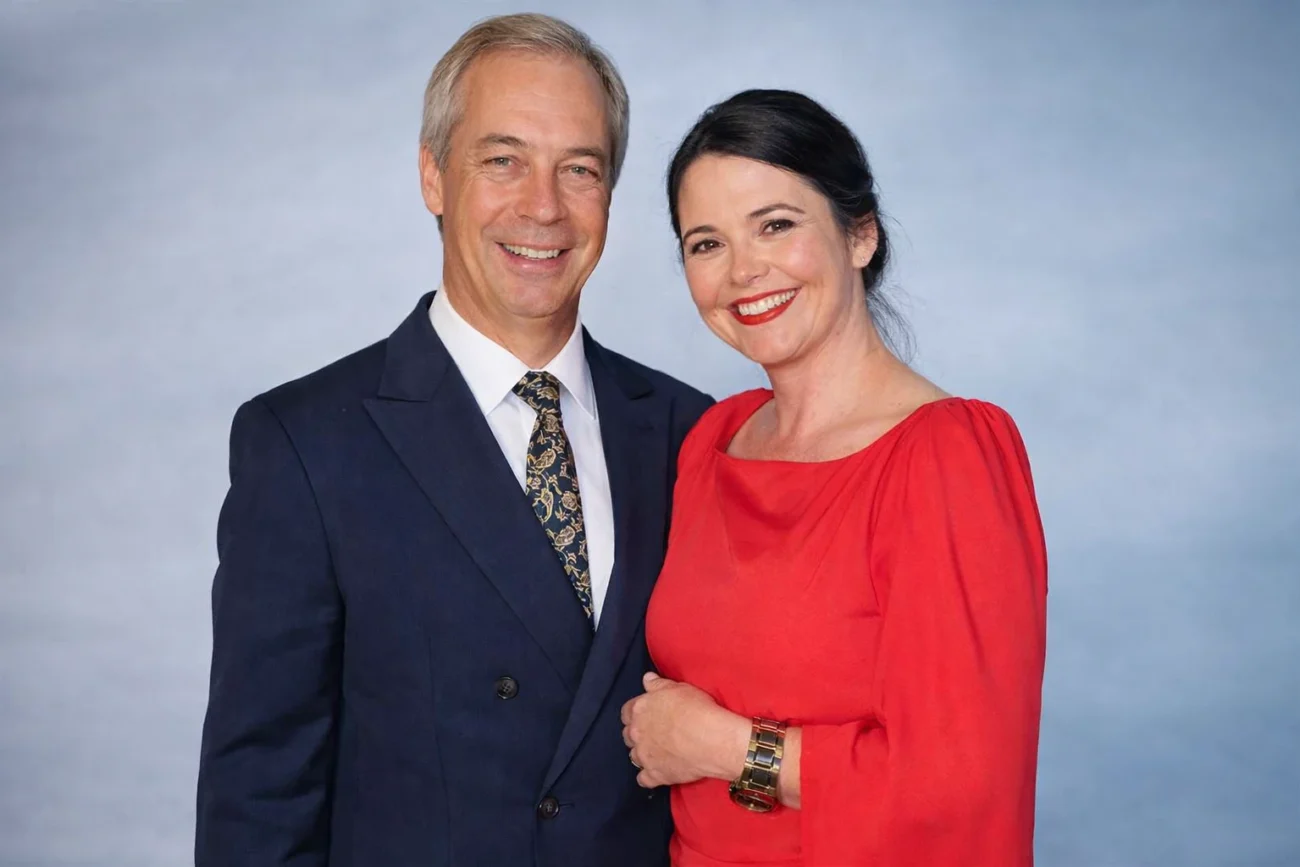
In the story of Nigel Farage—a man who built his career on visibility, confrontation, and political spectacle—there is a quieter, almost absent figure whose name continues to surface in searches and profiles: Gráinne Hayes. She appears at the edges of a defining moment in his early life, then recedes almost entirely from view. That contrast has turned her into a subject of curiosity, not because of what she has said or done publicly, but because of how little she has chosen to share.
For many readers, Hayes represents a before-and-after. Before Farage became one of Britain’s most polarizing political figures, before Brexit turned him into an international name, there was a private life that included a young Irish nurse who met him in a hospital ward. That relationship would lead to marriage, children, and nearly a decade of shared life—then, quietly, an end. What remains today is a story built from a handful of verifiable facts, surrounded by a great deal of speculation that says more about modern media than it does about Hayes herself.
Early Life and Irish Background
Gráinne Hayes is widely described as Irish by birth, though the specifics of her early life remain largely undocumented in reliable public records. There is no widely cited account of her hometown, her parents, or the circumstances in which she grew up. This absence is striking in an age where even minor public figures often have detailed digital footprints stretching back decades.
The truth is that Hayes’s early life has not been publicly chronicled in a meaningful way. Various websites offer confident claims about her upbringing, suggesting timelines and family details, but these are rarely supported by primary sources or credible reporting. In responsible biography writing, repetition does not equal verification, and in Hayes’s case, the verified record begins not in childhood, but in adulthood.
What can be said with reasonable confidence is that she trained as a nurse in Ireland before working in the United Kingdom. Nursing in the 1980s required formal education and clinical training, and Irish nurses have long been a significant part of the UK healthcare workforce. That context helps place Hayes within a broader professional pattern, even if the details of her own training remain private.
A Chance Meeting That Became a Turning Point
The moment that connects Gráinne Hayes to public history is not her own, but Nigel Farage’s. On 25 November 1985, Farage was seriously injured after being hit by a car in Orpington, south-east London. The accident left him with multiple injuries and required an extended period of hospitalization and recovery.
According to Farage’s own account, later referenced in interviews and reporting, it was during this recovery that he met Hayes, one of the nurses involved in his care. The circumstances are often presented simply, almost like a line from a novel: a patient and a nurse, brought together by a moment of crisis that turned into something more enduring. Yet beyond that basic outline, there are few detailed public descriptions of their early interactions.
What matters is that the relationship continued after Farage left the hospital. At the time, he was still a young man working in commodities trading, far removed from the political figure he would later become. Hayes, by contrast, was part of the healthcare system, a profession grounded in routine, discipline, and care. Their lives intersected at a moment of vulnerability, and that intersection became the foundation of a marriage.
Marriage and Family Life
Gráinne Hayes and Nigel Farage married in 1988, roughly three years after the accident that brought them together. Their marriage belonged to a period in Farage’s life that is often overshadowed by his later political career, but it was a formative chapter nonetheless.
The couple had two sons together, commonly identified in public records as Samuel, born in 1989, and Thomas, born in 1991. These details have appeared consistently across credible summaries of Farage’s personal life, though the children themselves have remained largely out of the public spotlight. That privacy appears to reflect a deliberate choice, one that aligns with Hayes’s own absence from media attention.
Not many people know this, but the years of Hayes and Farage’s marriage coincided with a time when he was not yet a political household name. He worked in finance and was only beginning to form the political views and affiliations that would later define his career. The marriage, therefore, unfolded outside the glare of national attention, in a more conventional domestic setting than many might assume.
Still, there is little detailed public reporting about their day-to-day life as a family. No interviews, no memoir excerpts from Hayes, and no extended third-party profiles have surfaced to describe their household dynamic. What remains is a basic outline: a marriage, two children, and a shared life that lasted nearly a decade.
Divorce and Separation
By 1997, the marriage had come to an end. Hayes and Farage divorced that year, closing a chapter that had begun with an unexpected meeting in a hospital ward. The reasons for the divorce have not been extensively detailed in reliable public sources, and neither party has offered a widely cited, in-depth public account of the separation.
That lack of detail is consistent with the broader pattern of Hayes’s life. Where many former spouses of public figures become part of ongoing narratives—through interviews, memoirs, or legal disputes—Hayes did not take on a public role in the aftermath of the divorce. She did not become a media commentator on Farage’s career, nor did she position herself within political discourse.
The truth is, the separation appears to have been handled largely outside the public eye. This is unusual in a media environment that often turns personal relationships into prolonged public stories. In Hayes’s case, the story effectively stopped at the point of divorce, leaving behind only the structural facts of the relationship.
Life After the Public Connection
After her divorce from Nigel Farage, Gráinne Hayes largely disappeared from public reporting. There is no strong evidence of her pursuing a public career, engaging in media appearances, or maintaining a visible profile tied to her former husband’s rising prominence.
Some online sources suggest she continued her work in healthcare or chose a quieter professional path, but these claims are not supported by clear documentation. Without verified interviews or records, it is difficult to draw firm conclusions about her post-divorce life. What can be said is that she did not follow the trajectory of many individuals who leverage a connection to fame into public visibility.
Here’s where it gets interesting. As Farage’s political career accelerated—through his leadership of the UK Independence Party, his central role in the Brexit campaign, and his later return to frontline politics—Hayes’s absence became more noticeable. In a narrative filled with strong personalities and constant media attention, her silence stood out.
That silence, however, should not be mistaken for mystery in the dramatic sense. It is more accurately understood as privacy maintained over time. Hayes appears to have made a consistent choice to remain outside the public conversation, even as her former husband became a figure of national and international debate.
Public Image by Absence
Gráinne Hayes does not have a public image in the conventional sense. There are no televised interviews, no widely circulated photographs beyond those associated with Farage’s early life, and no public statements that define her views or personality. What exists instead is a kind of negative space—a presence defined by absence.
This has had a predictable effect. In the absence of firsthand information, a number of low-quality biography websites have attempted to fill the gap with generalized descriptions. They often portray Hayes as “private,” “reserved,” or “family-oriented,” but these characterizations are rarely grounded in direct evidence. They reflect assumptions more than reporting.
But here’s the thing. The lack of a public persona can itself be meaningful. In a media environment that often rewards visibility, Hayes’s consistent absence suggests a deliberate boundary between her life and the public sphere. It is not simply that she is unknown; it is that she has remained largely unknowable by choice.
That distinction matters, especially when evaluating the reliability of online content about her. The more detailed and confident a profile appears without citing credible sources, the more likely it is to be speculative rather than factual.
Financial Status and Net Worth
There is no reliable public estimate of Gráinne Hayes’s net worth. Unlike public figures who generate income through visible careers, business ventures, or media appearances, Hayes’s financial situation has not been documented in a way that allows for credible estimation.
Some websites assign figures to her net worth, often placing it in a modest range compared to her former husband. However, these figures are typically unsupported by financial disclosures, verified assets, or reporting from established outlets. In the absence of such evidence, they should be treated with caution.
What can be inferred is limited. As a trained nurse, Hayes would have had a stable professional income during her working years. Any financial arrangements following her divorce, including potential settlements, have not been publicly detailed. Without verifiable data, any precise number would be speculative.
Relationship to Nigel Farage’s Later Life
Nigel Farage remarried in 1999 to German national Kirsten Mehr, with whom he has two daughters. His later family life, political career, and public persona have been extensively documented, often overshadowing the earlier chapter that included Hayes.
Despite this, Hayes remains part of Farage’s broader personal history. She represents a period before his transformation into a major political figure, and that connection continues to draw interest from readers seeking a fuller understanding of his life.
What’s surprising is how little that connection has translated into public commentary from Hayes herself. In many cases, former spouses of prominent figures become sources of insight or alternative perspectives. Hayes has not taken that path, reinforcing the sense that her life has moved in a different direction, away from public scrutiny.
Where Gráinne Hayes Is Now
There is no confirmed, up-to-date public record of where Gráinne Hayes lives today or what she is currently doing. Most credible accounts agree only on one point: she has maintained a private life, largely separate from the public narrative surrounding Nigel Farage.
This lack of information can be frustrating for readers seeking a complete biography, but it is also part of the story. Hayes’s life after her marriage has not been documented in detail, and there is no clear indication that she has sought to change that.
In a culture that often blurs the line between public and private life, Hayes’s case stands out. She remains a person known by name but not by public persona, connected to a widely recognized figure but not absorbed into his narrative.
Frequently Asked Questions
Who is Gráinne Hayes?
Gráinne Hayes is an Irish nurse best known as the first wife of British politician Nigel Farage. She met him while he was recovering from a serious car accident in 1985, and they married in 1988. Their connection is the primary reason her name appears in public records.
How long were Gráinne Hayes and Nigel Farage married?
They were married for approximately nine years, from 1988 until their divorce in 1997. Their marriage took place before Farage became widely known in British politics.
Did Gráinne Hayes have children?
Yes, she had two sons with Nigel Farage. Public sources commonly identify them as Samuel and Thomas, both of whom have largely stayed out of the public spotlight.
What does Gráinne Hayes do now?
There is no verified public information about her current profession or daily life. It is generally believed that she has continued to live privately, but specific details are not confirmed in reliable sources.
Is there information about her early life?
Very little. Her early life in Ireland, including her family background and education, has not been widely documented in credible public records.
What is Gráinne Hayes’s net worth?
There is no confirmed estimate of her net worth. Figures found online are usually speculative and not backed by verifiable financial data.
Conclusion
Gráinne Hayes occupies a rare position in modern biography: she is known, yet largely undocumented. Her connection to Nigel Farage ensures that her name remains searchable, but her own life has not been shaped by public attention in the same way.
The story that can be told about Hayes is, in many ways, defined by its limits. It includes a profession in nursing, a marriage that intersected with a formative moment in Farage’s life, and a family that remains mostly private. Beyond that, the record grows quiet.
That quietness is not a gap to be filled with speculation. It is a reflection of a life lived outside the structures of public narrative. In an age where exposure often feels unavoidable, Hayes’s enduring privacy may be the most telling detail of all.
For readers, the takeaway is simple but important. Not every person connected to fame becomes a public figure, and not every story expands with time. Sometimes, the most honest biography is the one that respects what cannot be known.
