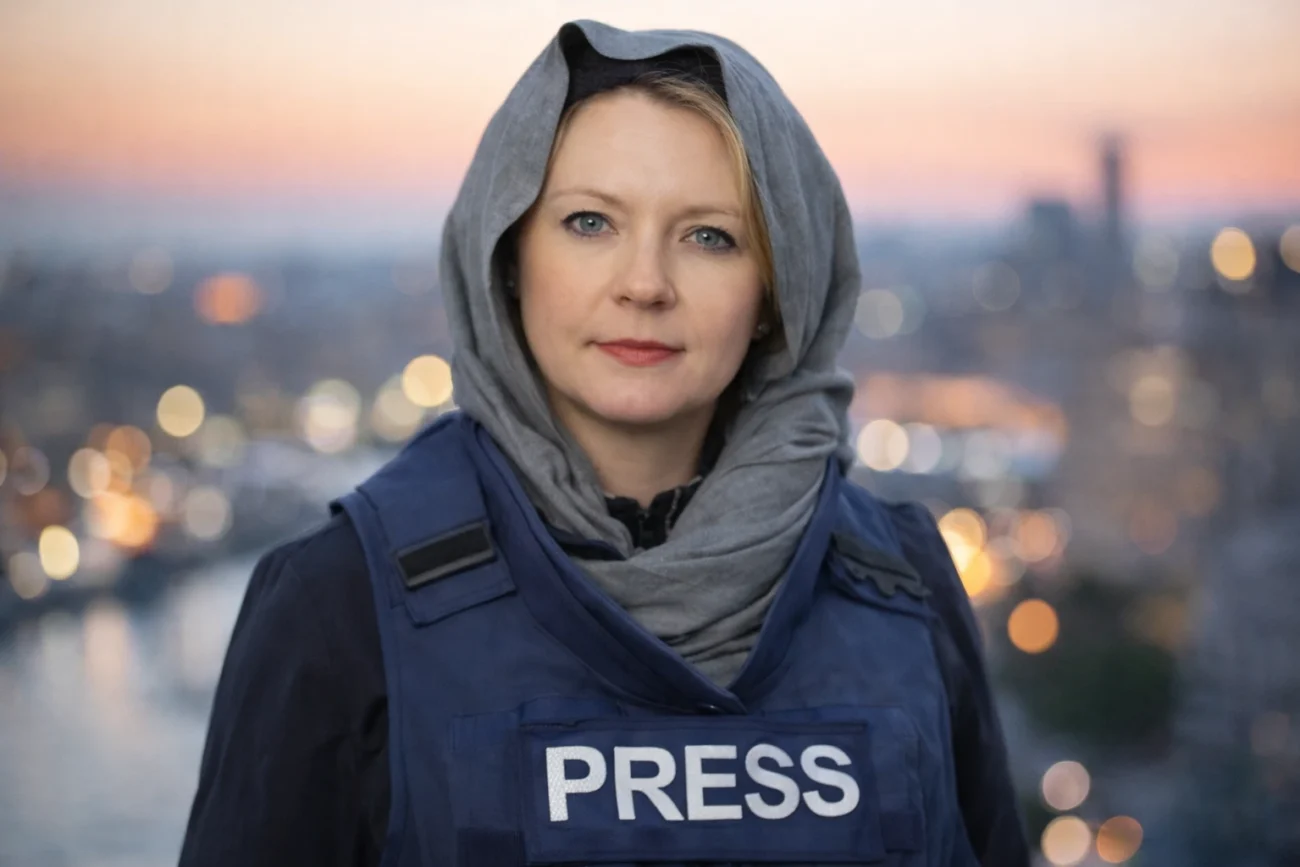
The camera is steady, but the ground beneath it rarely is. In one recent ITV News report from Lebanon, Emma Murphy stands amid the aftermath of airstrikes, speaking calmly about displacement, fear, and the brutal calculations civilians are forced to make in wartime. There is no theatrics in her delivery, no attempt to center herself in the chaos. Instead, she does what she has done for years: she reports what is there, as clearly as she can, and moves on to the next question.
For viewers in the United Kingdom and beyond, Murphy has become a familiar presence during moments of global crisis. She is ITV News’ International Editor, a senior role that places her at the front lines of reporting on war, diplomacy, and political upheaval. Her work spans continents and conflicts, from Washington politics to Middle Eastern war zones, and her reputation rests less on personality than on persistence.
Yet despite her growing visibility, Emma Murphy remains something of a paradox in modern media. She is widely respected within journalism, frequently seen on television, and trusted with some of the most complex stories of the moment. At the same time, she has maintained a relatively low public profile outside her work, with limited personal details available in verified sources. That balance between visibility and privacy has only increased curiosity about who she is and how she built her career.
Early Life and Background
Compared with many public figures, Emma Murphy’s early life is not extensively documented in widely accessible, high-trust sources. This is not unusual for journalists who rose through traditional newsroom pathways rather than celebrity-driven careers. Official ITV material focuses almost entirely on her professional achievements, offering little confirmed information about her childhood, family background, or formative years.
What can be inferred, cautiously, is that Murphy followed a path typical of many British broadcast journalists: education leading into early reporting roles, followed by progression through increasingly demanding assignments. The absence of detailed public biographical data has not limited her professional visibility, but it does mean that readers should be careful about relying on secondary websites that claim precise personal details without verifiable sourcing.
This relative privacy has shaped how Murphy is perceived. Unlike media personalities who cultivate a public persona through interviews, social media, or lifestyle coverage, she is known primarily through her reporting. Her identity is tied to the stories she covers rather than the story of her own life, which is increasingly rare in an era where personal branding often overlaps with journalism.
Education and Entry into Journalism
Specific information about Murphy’s education is not consistently confirmed in official or high-trust sources. However, her career trajectory suggests a foundation typical of senior UK broadcast journalists, likely involving academic study followed by early newsroom experience or trainee reporting roles.
What stands out is not a single breakthrough moment but a steady progression. Murphy did not emerge suddenly into public attention. Instead, she appears to have built her career through sustained work across different beats, developing the skills required for political reporting, international coverage, and live broadcasting under pressure.
That kind of progression often involves years of reporting at regional or national levels before moving into international roles. While the details of those early steps are not widely documented, her later positions make clear that she had already established credibility long before becoming a visible on-air figure in major global stories.
Career Breakthrough and Rise at ITV News
Emma Murphy’s association with ITV News is central to her professional identity. ITV, one of the United Kingdom’s major broadcasters, has long maintained a strong tradition of foreign correspondence, and Murphy’s rise within the organization reflects both her individual reporting skills and the network’s investment in international journalism.
She has held several key roles at ITV, including Washington Correspondent and Europe Correspondent, before becoming International Editor. Each of these positions represents a significant level of responsibility. The Washington role involves covering U.S. politics, one of the most scrutinized and complex beats in global journalism. The Europe role requires navigating multinational politics, policy debates, and regional crises.
Her appointment as International Editor marked a shift from correspondent to senior editorial voice. In that role, Murphy not only reports from the field but also helps shape how ITV News covers international events. She becomes both a witness and an interpreter, translating fast-moving, often chaotic developments into narratives that viewers can understand.
What’s notable is how her career reflects continuity rather than reinvention. There is no clear break where she suddenly became prominent. Instead, her profile has grown alongside the increasing importance of the stories she covers.
Reporting from Conflict Zones
Murphy’s recent work has focused heavily on the Middle East, particularly Lebanon and Iran-related developments. These assignments place her in environments where information is contested, access is limited, and personal safety can be a concern.
In Lebanon, her reporting has documented the effects of ongoing conflict on civilians. One ITV segment described neighborhoods reduced to rubble and families forced to weigh the risks of staying versus fleeing. Another report focused on the physical and psychological impact of war on children, incorporating testimony from medical professionals treating severe injuries.
These reports show a consistent approach. Murphy does not frame conflict solely through military or political analysis. Instead, she connects policy decisions to their human consequences, often bringing viewers into hospitals, homes, and communities affected by violence.
At the same time, her reporting includes attention to official narratives. She covers statements from government officials, military claims, and diplomatic developments, placing them alongside on-the-ground realities. This balance allows viewers to see both the strategic and human dimensions of conflict, even when they do not align neatly.
Covering Politics: Washington and Beyond
Before her current role, Murphy served as ITV’s Washington Correspondent, covering U.S. politics during a period of intense polarization and change. This assignment required a different set of skills from conflict reporting, including deep knowledge of political institutions, election cycles, and policy debates.
Her work in Washington included analysis of the transition to President Joe Biden’s administration. In one ITV piece, she wrote about the need to understand shifts in American political identity, suggesting a reporter interested in underlying trends rather than surface-level events.
That experience appears to have shaped her later reporting. Even in conflict zones, Murphy often connects events to broader political dynamics, whether it is international alliances, domestic pressures within governments, or competing narratives about success and failure.
This ability to move between political analysis and field reporting is one of the defining features of her work. It allows her to provide context without losing sight of immediate realities, a balance that is difficult to maintain in fast-moving news environments.
Notable Stories and Career Moments
Over the course of her career, Murphy has covered a wide range of significant events. One of the most widely recalled is her reporting during the Raoul Moat manhunt in 2010. In later reflections, she described the tension and uncertainty of that period, including a direct encounter with the gunman during the search.
That experience highlights a key aspect of her work: the unpredictability of live reporting. Journalists in the field often face situations that cannot be scripted or fully controlled, and Murphy’s account of that moment underscores the risks involved even in domestic reporting.
Another notable area of her work includes coverage linked to Haiti following the devastating earthquake. In collaboration with humanitarian organizations, ITV reporting involving Murphy sought to show the impact of the disaster through individual stories, emphasizing the lives behind the statistics.
More recently, her reporting from the Middle East has become central to ITV’s international coverage. These stories have addressed not only the immediate effects of conflict but also broader questions about long-term instability, regional politics, and humanitarian response.
Awards and Industry Recognition
Emma Murphy’s work has earned recognition within the journalism industry, though detailed lists of her awards are not always publicly compiled in one place. ITV’s official profile states that she has won numerous awards for her coverage, reflecting long-term professional respect.
In 2026, she was nominated for the Royal Television Society’s Network Television Journalist of the Year award. The RTS awards are considered one of the more serious honors in British broadcast journalism, judged by industry peers and experts.
Murphy has also been associated with award-winning ITV News coverage, including work recognized at the BAFTA Television Awards for news reporting. While these awards often recognize entire programs rather than individual reporters, they provide context for the quality of the newsroom and projects she has been part of.
Recognition of this kind is not only about prestige. It signals trust within the industry, suggesting that Murphy’s work meets high standards of accuracy, clarity, and impact.
Personal Life and Privacy
One of the most striking aspects of Emma Murphy’s public profile is how little is confirmed about her personal life. Unlike many public figures, she does not appear to have cultivated a public-facing persona beyond her journalism.
There is no widely confirmed information about her marital status, children, or family life in official or high-trust sources. Some online profiles attempt to fill these gaps, but their claims are often unsupported by verifiable evidence.
This absence of personal detail is not necessarily unusual in journalism, particularly among correspondents who focus on reporting rather than commentary or opinion. It reflects a professional culture in which the story takes precedence over the storyteller.
For readers, this means accepting a certain level of uncertainty. While curiosity about personal details is natural, the most reliable information about Murphy remains her work and career trajectory.
Public Image and Professional Style
Emma Murphy’s public image is shaped almost entirely by her reporting style. She is known for a calm, measured delivery that avoids sensationalism, even when covering highly emotional or dangerous situations.
Her approach contrasts with more personality-driven forms of television journalism. She does not rely on dramatic presentation or strong personal branding. Instead, she focuses on clarity, context, and evidence.
This style has both strengths and limitations. On one hand, it builds trust and credibility, particularly in complex or sensitive stories. On the other hand, it may make her less visible in media environments that reward strong personal identities and social media presence.
That said, her continued prominence in ITV’s international coverage suggests that this approach still resonates with audiences and editors alike.
Where Emma Murphy Is Now
As of 2026, Emma Murphy continues to serve as ITV News’ International Editor. Her recent work has focused heavily on the Middle East, reflecting ongoing geopolitical tensions and conflicts that dominate global news.
She remains a regular presence on ITV broadcasts, reporting from the field as well as providing analysis from key locations. Her role places her at the intersection of journalism and global events, requiring both on-the-ground reporting and broader contextual understanding.
What’s likely is that her work will continue to evolve alongside the stories she covers. International journalism is shaped by events as much as by individual careers, and Murphy’s trajectory suggests that she will remain closely tied to the world’s most pressing issues.
Frequently Asked Questions
Who is Emma Murphy?
Emma Murphy is a British journalist and the International Editor for ITV News. She is known for her reporting on global conflicts, political developments, and major international events.
What is Emma Murphy known for?
She is best known for her work as a foreign correspondent, including coverage from conflict zones such as Lebanon and political reporting from Washington. Her reporting often focuses on both the human and political dimensions of major stories.
Has Emma Murphy won any awards?
She has received industry recognition, including a nomination for the Royal Television Society’s Network Television Journalist of the Year award in 2026. ITV also states that she has won multiple awards during her career.
What is Emma Murphy’s role at ITV News?
She serves as International Editor, a senior position that involves reporting on global events and helping shape the network’s international coverage.
Is Emma Murphy married?
There is no widely confirmed public information about her marital status or personal relationships. Most reliable sources focus on her professional work rather than her private life.
Where is Emma Murphy working now?
She continues to work with ITV News as International Editor, reporting on major international stories and appearing regularly on television broadcasts.
Conclusion
Emma Murphy’s career offers a clear example of what long-term journalism looks like when it is built on consistency rather than spectacle. She has moved through some of the most demanding roles in broadcast news, from political reporting in Washington to conflict coverage in the Middle East, without shifting away from a core focus on factual, grounded storytelling.
Her relative privacy adds to the sense that her work speaks for itself. In a media environment where visibility often depends on personality, Murphy has remained defined by her reporting. That choice, whether intentional or not, has helped preserve a sense of trust in her coverage.
The truth is, her story is still unfolding. International journalism is shaped by events that no one can predict, and Murphy’s career will continue to follow those developments. What remains constant is her presence where the story is hardest to tell.
For readers trying to understand who Emma Murphy is, the answer is less about biography and more about work. She is a journalist who shows up, reports carefully, and leaves viewers with a clearer sense of what is happening and why it matters. In a world where clarity is often in short supply, that remains a valuable role.
