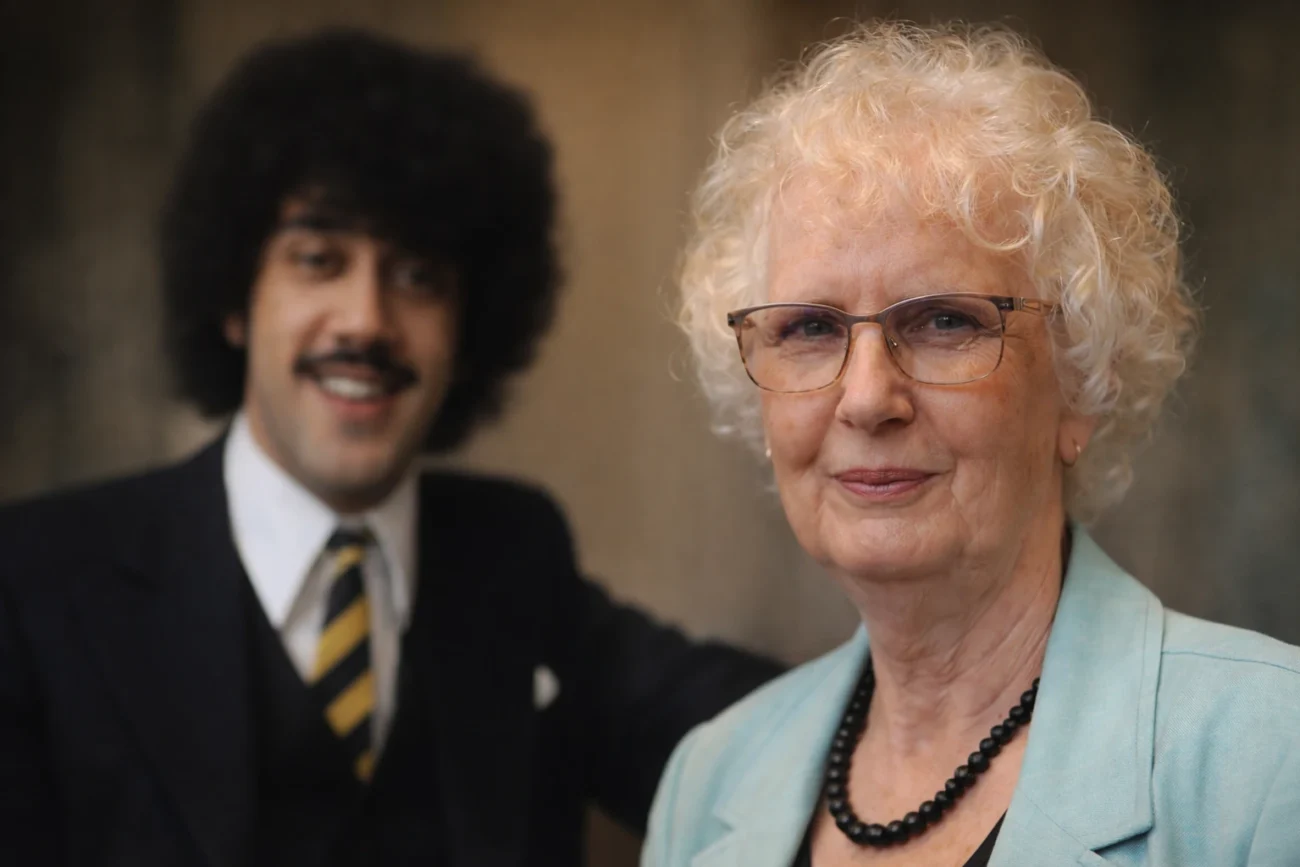
There is a certain kind of public figure who never quite seeks attention but remains permanently tied to it. Caroline Crowther belongs to that category. Her name surfaces not because she chased fame, but because she stood close to it at a defining moment in music history. As the former wife and widow of Thin Lizzy frontman Phil Lynott, she has long occupied a quiet but central place in the story of one of rock’s most enduring figures.
For decades, Crowther has resisted the usual patterns of celebrity exposure. She rarely gives interviews, appears selectively in documentaries, and keeps her personal life largely shielded from public curiosity. Yet interest in her has only grown over time, driven by renewed attention to Lynott’s legacy and a broader desire to understand the private life behind the myth.
Early Life and Family Background
Caroline Crowther was born into a family already familiar with public life. She is the daughter of Leslie Crowther, a well-known British comedian and television presenter whose career spanned decades of mainstream entertainment in the United Kingdom. Leslie Crowther became a household name through variety shows and game programs, bringing a steady, reassuring presence to British television screens.
Growing up in that environment meant Caroline was not entirely removed from the world of performance and media. However, unlike her father, she did not pursue a public career in entertainment. Her appearances in television archives, including a 1970s episode of This Is Your Life honoring her father, show her as part of a family unit rather than a personality in her own right.
Not many people know this, but being raised in a well-known household does not automatically translate into a desire for fame. In Crowther’s case, it appears to have had the opposite effect. She remained largely private even as her family connections placed her within reach of public attention, a pattern that would continue throughout her life.
Meeting Phil Lynott
Caroline Crowther’s life entered a different orbit when she met Phil Lynott, the Irish musician who would become one of the defining voices of 1970s rock. By the time they crossed paths, Lynott had already achieved success as the frontman of Thin Lizzy, known for hits like “The Boys Are Back in Town” and “Jailbreak.”
Their relationship developed during a period when Lynott’s career was at its peak. He was widely admired for his charisma, songwriting, and stage presence, but also navigating the pressures that came with international fame. For Crowther, the relationship meant stepping into a world that was both glamorous and demanding, shaped by touring schedules, media attention, and the unpredictability of rock culture.
The truth is, their relationship has never been documented in detail with the kind of day-to-day specificity that fuels celebrity biographies. What can be confirmed is that the two formed a serious partnership that led to marriage in 1980. From that point forward, Crowther became part of Lynott’s personal and family life, rather than just a figure on the edge of his public story.
Marriage and Family Life
Caroline Crowther and Phil Lynott married in 1980, marking a period when Lynott appeared to be trying to build a stable family life alongside his music career. They had two daughters together, Sarah and Cathleen, who would later become important figures in preserving their father’s legacy.
For a time, the family lived in Ireland, and Lynott spoke publicly about his desire to balance his identity as a rock star with his role as a husband and father. This dual life, however, proved difficult to sustain. The demands of touring, combined with personal struggles, placed increasing strain on the marriage.
By around 1984, reports indicate that Crowther and Lynott had separated. Despite this, they had not divorced by the time Lynott died in January 1986. This distinction matters because it places Crowther in the position of both former partner and legal widow, a role that would shape how she was viewed in the years that followed.
Family life during those years has often been overshadowed by Lynott’s public persona. But here’s where it gets interesting. Accounts from archives and later documentaries suggest that the domestic side of his life was more grounded than his image suggested. Crowther’s presence during that period represents an attempt to create normalcy within a life that was anything but ordinary.
The Loss of Phil Lynott
Phil Lynott’s death on January 4, 1986, at the age of 36 marked a turning point not only in music history but in the lives of those closest to him. For Caroline Crowther, the loss was both deeply personal and unavoidably public. Lynott’s funeral drew widespread attention, with family members, including Crowther, their daughters, and his mother Philomena Lynott, in attendance.
The circumstances surrounding Lynott’s death have been widely discussed, often focusing on the excesses associated with rock culture. But the human impact on his family is less frequently explored. Crowther was left to navigate life after his death while raising two young children, all under the shadow of a legacy that would continue to grow.
What’s striking is how little she chose to say publicly in the years immediately following his death. While many figures connected to famous musicians build public narratives around their experiences, Crowther remained largely silent. That decision shaped her reputation as a private figure and set the tone for how she would handle her connection to Lynott’s legacy moving forward.
Life After Lynott
In the decades after Phil Lynott’s death, Caroline Crowther maintained a low profile. There is limited public documentation of her personal life during this period, which reflects both her preference for privacy and the lack of media intrusion compared to more visible celebrity figures.
Her name occasionally appeared in connection with Thin Lizzy-related matters, particularly in business and legal records tied to the band’s legacy. These records suggest that she has been involved, directly or indirectly, in managing aspects of Lynott’s intellectual property and estate. This includes roles associated with companies linked to Thin Lizzy’s brand and catalog.
That said, the details of her day-to-day involvement remain largely private. There are no widely reported interviews outlining her role, and she has not positioned herself as a public spokesperson for Lynott’s legacy. Instead, her involvement appears to operate quietly behind the scenes, focusing on stewardship rather than visibility.
Role in Preserving the Thin Lizzy Legacy
As interest in Phil Lynott has grown over the years, so too has the importance of those responsible for maintaining his legacy. Caroline Crowther is part of that group, even if her role is not always publicly defined. Company records in the United Kingdom link a Caroline Susan Taraskevics to Thin Lizzy-related enterprises, indicating an ongoing connection to the business side of Lynott’s work.
So what does this mean in practice? It means that decisions about licensing, reissues, and public representation of Lynott’s music often pass through structures in which Crowther has been involved. These decisions shape how new audiences encounter Thin Lizzy, whether through documentaries, anniversary releases, or cultural tributes.
There’s a quiet authority in that position. While fans may focus on the music itself, the continued presence of that music in public life depends on careful management. Crowther’s role suggests a commitment to preserving Lynott’s work in a way that balances commercial interests with respect for his artistic legacy.
Documentary Appearances and Renewed Interest
For many years, Caroline Crowther remained almost entirely absent from media portrayals of Phil Lynott. That changed with the release of Phil Lynott: Songs for While I’m Away, a documentary that offered a more personal look at the musician’s life. Crowther appeared in the film under the name Caroline Taraskevics, alongside her daughters.
Her participation marked a rare moment of public engagement. Viewers were able to hear directly from someone who had shared Lynott’s life during a critical period, adding depth to a story often dominated by performance footage and secondhand accounts.
The response to the documentary brought renewed attention to her name. Audiences who were discovering Lynott for the first time, or revisiting his story, sought out more information about the people closest to him. Crowther’s appearance helped shift the narrative from legend to lived experience, highlighting the emotional and familial dimensions of Lynott’s life.
Public Image and Personal Privacy
Caroline Crowther’s public image is defined as much by what she has not done as by what she has. She has not pursued media attention, written memoirs, or built a public-facing career based on her connection to Phil Lynott. Instead, she has maintained a consistent distance from the spotlight.
That restraint has shaped how she is perceived. To some, it suggests a deliberate effort to protect her family’s privacy. To others, it reflects a broader choice to live outside the expectations placed on those connected to famous figures. Either way, it has resulted in a public profile that is limited but respected.
Here’s the thing. In an era where personal stories are often commodified, Crowther’s approach stands out. By choosing when and how to engage with public interest, she has retained control over her narrative, even as curiosity about her life continues.
Financial Standing and Net Worth
Reliable information about Caroline Crowther’s financial standing is limited. Unlike many public figures, she has not disclosed details about her income or assets, and there are no widely accepted estimates of her net worth. Any figures circulating online should be treated with caution, as they often lack credible sourcing.
What can be said is that her association with Thin Lizzy-related companies suggests a connection to revenue streams tied to Lynott’s music. These may include royalties, licensing agreements, and other forms of intellectual property income. However, without verified disclosures, it is not possible to assign a specific financial value to her holdings.
This lack of transparency is not unusual for someone in her position. Estate management often involves complex arrangements that are not fully visible to the public, particularly when handled through corporate structures.
Where Caroline Crowther Is Now
As of 2026, Caroline Crowther remains a largely private individual. Her most visible recent appearance was in the Phil Lynott documentary, which introduced her to a new generation of viewers. Beyond that, her public presence is minimal, with occasional mentions in connection to Thin Lizzy’s ongoing legacy.
Her daughters, Sarah and Cathleen Lynott, have taken on a more visible role in representing their father’s memory. Through interviews and media appearances, they have helped shape the modern understanding of Phil Lynott, often bringing a personal perspective that complements historical accounts.
Crowther’s current life appears to be centered away from public attention, with her influence felt more through legacy work than personal visibility. That balance between presence and privacy has remained consistent throughout her life, and there is little indication that it will change.
Frequently Asked Questions
Who is Caroline Crowther?
Caroline Crowther is best known as the former wife and widow of Phil Lynott, the lead singer of Thin Lizzy. She is also the daughter of British entertainer Leslie Crowther. Her public profile is closely tied to her family connections rather than an independent career in the spotlight.
Was Caroline Crowther married to Phil Lynott?
Yes, she married Phil Lynott in 1980. The couple separated around 1984 but had not divorced before Lynott’s death in 1986. This makes her both his former partner and legal widow.
How many children does Caroline Crowther have?
She has two daughters with Phil Lynott: Sarah Lynott and Cathleen Lynott. Both have appeared in documentaries and media coverage related to their father’s life and legacy.
Why is she sometimes called Caroline Taraskevics?
In recent years, she has been credited as Caroline Taraskevics in film appearances and company records. This name is widely understood to refer to the same individual, though the details of the name change are not publicly explained.
Is Caroline Crowther involved in Thin Lizzy’s legacy?
Yes, public records suggest she has been involved in companies connected to Thin Lizzy and Phil Lynott’s estate. Her role appears to focus on managing aspects of his legacy rather than public representation.
What is Caroline Crowther doing now?
She remains a private figure, with limited public appearances. Her most recent notable involvement was in the Phil Lynott documentary, and she is believed to continue playing a role in managing his legacy behind the scenes.
Conclusion
Caroline Crowther’s life is not defined by headlines or public milestones, but by proximity to a figure whose influence continues to resonate. Her connection to Phil Lynott places her within a story that extends far beyond the years they spent together, touching on music, culture, and memory.
What stands out is her consistency. Through decades of changing media landscapes and renewed interest in Lynott’s work, she has maintained a steady commitment to privacy. That choice has shaped not only her own life but also the way her story is told.
Her role in preserving Lynott’s legacy, while largely unseen, carries real weight. It reflects a form of stewardship that values continuity over visibility, ensuring that the work itself remains central.
In a culture that often demands constant exposure, Caroline Crowther offers a different model. She remains present where it matters, but absent where it does not, leaving behind a legacy defined not by noise, but by quiet endurance.
