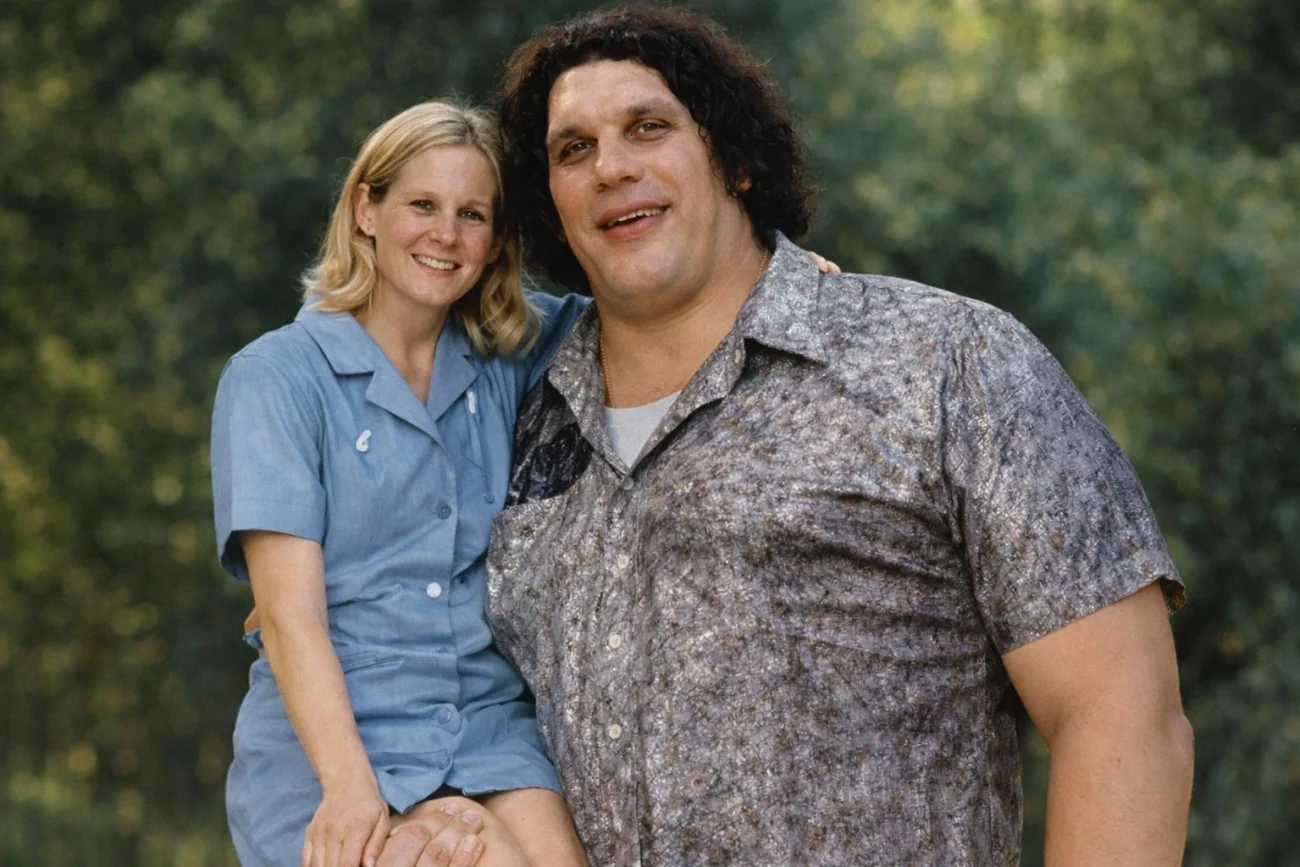
Jean Christensen is one of those figures who exist in the margins of fame—close enough to a legend to be remembered, yet distant enough that much of her own story remains indistinct. For most people, her name surfaces in connection with André the Giant, one of professional wrestling’s most enduring icons. But reducing Christensen to a footnote in his life misses the fuller, if quieter, significance of her role. She was part of the wrestling world in her own right, a mother who raised André’s only known child, and a private figure whose life reveals how celebrity can obscure as much as it illuminates.
Her story is not one of red carpets or public accolades. Instead, it unfolds in fragments: a professional presence behind the scenes of wrestling, a relationship with a man whose fame stretched across continents, and a life largely lived outside the spotlight. That absence of visibility has left gaps in the historical record, but it also offers something rare—a chance to understand the human reality behind a mythologized figure like André the Giant through the people closest to him.
Early Life and Background
Little verifiable information exists about Jean Christensen’s early life, and that scarcity shapes how her biography must be told. Unlike celebrities whose childhoods are documented in interviews and profiles, Christensen appears to have lived a largely private existence before entering the wrestling world. Public records and reliable sources do not clearly establish her birthplace, family background, or education, and many online claims about these details remain unconfirmed.
What can be said is that Christensen came of age in a period when professional wrestling was evolving into a global entertainment industry. The late 1960s and early 1970s marked a transition from regional promotions to broader visibility, especially in North America. It was within this shifting environment that she would later find her place, not in the ring but behind the scenes.
The lack of detail about her early years should not be mistaken for insignificance. It reflects a broader reality for many people connected to entertainment industries who were never the focus of public attention. In Christensen’s case, that anonymity would remain a defining feature of her life, even as she became linked to one of wrestling’s most recognizable figures.
Entering the Wrestling World
Jean Christensen’s documented connection to professional wrestling appears to have come through work in public relations. During the early 1970s, wrestling promotions relied heavily on local publicity, media coordination, and event promotion to build audiences. People in roles like Christensen’s were essential to shaping how wrestlers were presented to the public, even if their names rarely appeared in headlines.
It was in this professional setting that she met André René Roussimoff, better known as André the Giant. At the time, André was already becoming a major attraction, known for his extraordinary size and presence. His career required constant travel, with appearances across territories and, increasingly, across countries.
Their meeting reflects how relationships often formed within the wrestling circuit. The industry functioned as a close-knit but mobile community, where performers and staff crossed paths repeatedly. Christensen’s role placed her in proximity to that world, making her connection with André both plausible and grounded in the realities of the business.
Relationship with André the Giant
The relationship between Jean Christensen and André the Giant is central to her public identity, but it is also one of the most misunderstood aspects of her life. Many online accounts describe her as André’s wife, yet clear documentation of a legal marriage remains elusive. More careful accounts refer to her as his partner, a distinction that matters in separating verified facts from repeated assumptions.
Their relationship unfolded against the backdrop of André’s demanding career. Wrestling at his level required near-constant travel, with schedules that could keep him on the road for most of the year. This lifestyle made sustained domestic life difficult, and it likely shaped the nature of their connection.
What emerges from the available record is a relationship that was real but not traditionally structured. It was defined by distance, professional commitments, and the pressures of fame. That complexity often gets flattened in simplified retellings, but it is essential to understanding both Christensen’s experience and André’s personal life.
Motherhood and Robin Christensen-Roussimoff
Jean Christensen’s most enduring role is as the mother of Robin Christensen-Roussimoff, born in 1979. Robin is widely recognized as André the Giant’s only known child, and through her, Christensen’s place in wrestling history is firmly established. While André’s career placed him in arenas around the world, Robin’s upbringing was far more grounded.
Accounts from Robin herself indicate that she was raised primarily by her mother and had limited contact with her father during her childhood. André’s travel schedule, which reportedly kept him away for the majority of the year, made regular family life difficult. As a result, Christensen appears to have taken on the primary responsibility for raising their daughter.
This aspect of her life offers a clearer picture of who she was beyond her association with André. She was not simply a figure connected to a celebrity; she was a parent navigating the challenges of raising a child in the shadow of that celebrity. Her decisions, including keeping Robin at a distance from the wrestling world during her early years, suggest a focus on stability and privacy.
Life Outside the Spotlight
One of the most striking features of Jean Christensen’s biography is how little of it unfolded in public view. Even after her connection to André became known, she did not emerge as a public personality. There are no widely circulated interviews, no memoirs, and no sustained media presence that would offer a fuller account of her perspective.
This absence is not unusual for individuals connected to high-profile figures, particularly in earlier decades. Before the rise of social media and the constant documentation of private lives, it was possible to remain largely out of public view. Christensen appears to have maintained that distance, even as interest in André’s life grew.
What’s surprising is how that privacy has persisted. In an era when even minor figures connected to celebrities often become subjects of intense scrutiny, Christensen’s life remains only partially documented. This suggests a deliberate choice, or at least a consistent pattern, of staying out of the public eye.
Public Perception and Misconceptions
The limited information about Jean Christensen has led to a range of misconceptions. One of the most common is the assumption that her life is fully documented and easily understood. In reality, much of what circulates online is repeated without clear sourcing, creating an illusion of certainty where none exists.
Another misconception is the tendency to define her solely through her relationship with André the Giant. While that relationship is central to her public identity, it does not capture the entirety of her life. She was a professional in her own right and a mother whose role had lasting significance.
The challenge for readers is to approach her story with a degree of caution. Not every detail presented online can be verified, and distinguishing between fact and repetition requires attention to the quality of sources. In Christensen’s case, the most reliable insights come from accounts tied to her daughter and to serious biographies of André.
Influence Through Legacy
Jean Christensen’s influence is not measured in public achievements or accolades but in legacy. Through her daughter Robin, she remains connected to André the Giant’s enduring cultural presence. Robin has participated in events and discussions that keep her father’s memory alive, and in doing so, she also carries forward the story of her mother.
This indirect influence highlights a different way of understanding impact. Christensen did not seek visibility, yet her role in shaping the life of André’s only child gives her a lasting place in his story. It is a reminder that influence often operates quietly, through relationships and family rather than through public recognition.
Her legacy also reflects the complexities of life around celebrity. Being close to a famous figure can bring attention, but it can also obscure individual identity. Christensen’s story illustrates both sides of that dynamic, showing how a person can be remembered primarily through their connection to someone else.
Where Jean Christensen Is Now
Public information about Jean Christensen’s later life and current status is limited. There are no widely confirmed reports detailing her activities in recent years, and it is unclear whether she remains alive or has passed away. This lack of clarity underscores the broader pattern of privacy that has defined her life.
For many readers, this uncertainty may feel unsatisfying. But it is also a reflection of reality. Not every life connected to fame is documented in detail, and not every question has a clear answer. In Christensen’s case, the absence of information is itself part of her story.
Her daughter Robin continues to be the more visible link to André the Giant, appearing in interviews and participating in projects related to his legacy. Through Robin, the connection to Jean Christensen remains present, even if details about her own life remain largely private.
Frequently Asked Questions
Who is Jean Christensen?
Jean Christensen is best known as the mother of Robin Christensen-Roussimoff and for her relationship with André the Giant. She was connected to the professional wrestling world, likely through work in public relations, but she remained largely out of the public spotlight. Much of her personal history is not well documented in reliable sources.
Was Jean Christensen married to André the Giant?
Many online sources describe her as André the Giant’s wife, but there is no widely confirmed documentation of a legal marriage. More reliable accounts refer to her as his partner. The distinction is important because it reflects the uncertainty in the historical record.
Did Jean Christensen have children?
Yes, she had one daughter, Robin Christensen-Roussimoff, born in 1979. Robin is recognized as André the Giant’s only known child and has participated in preserving her father’s legacy through public appearances and interviews.
What did Jean Christensen do for a living?
She is believed to have worked in public relations within the professional wrestling industry during the 1970s. This role would have involved promoting events and managing media interactions, placing her in close contact with wrestlers like André the Giant.
Why is so little known about Jean Christensen?
Jean Christensen lived a largely private life and was not a public figure in her own right. Much of the available information about her comes from her connection to André the Giant and from accounts related to her daughter. The lack of primary sources has limited the amount of verifiable detail about her life.
Is Jean Christensen still alive?
There is no widely confirmed public information about her current status. Some sources speculate about her later life, but without reliable documentation, it is not possible to state definitively whether she is still alive.
Conclusion
Jean Christensen’s life resists the neat narratives often applied to people connected to fame. She was neither a public celebrity nor a fully documented historical figure, yet her connection to André the Giant ensures that her name continues to surface. What can be said with confidence is that she played a significant role in his personal life and in the upbringing of their daughter.
Her story highlights the limits of public knowledge. It shows how easily details can be repeated without verification and how important it is to distinguish between fact and assumption. In a culture that often demands complete biographies, Christensen’s life reminds us that some stories remain partial.
There is also something quietly powerful in that. Jean Christensen’s legacy does not depend on headlines or public recognition. It lives on through her daughter and through the deeper understanding of André the Giant’s life that her story helps to provide. In that sense, her influence endures, even if much of her life remains beyond the reach of the public record.
